ネクタイについて
販売:
このデザインについて
velvetとsilk要素はクリエイターによるアートワーク上のシミュレーションです。この商品の製作においてこれらの要素は使用されません。
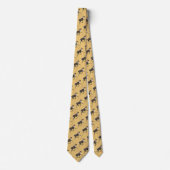
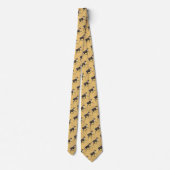
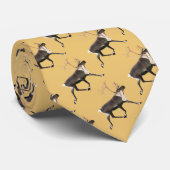
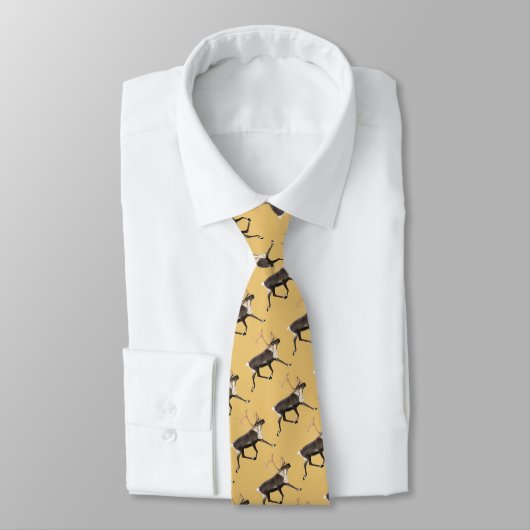
Bull Caribou Neck Tie ネクタイ
An image of a bull caribou superimposed on a background color suggesting brain-tanned leather. The caribou (Rangifer tarandus), known as the reindeer outside of North America, is a deer of the Arctic and Subarctic. While overall widespread and numerous, some subspecies are rare and one has gone extinct. The Inuit word tuktu means - deer that never stops moving. Caribou are always on the move, going north to calve, heading for the winter grounds, and south in the summer. Caribou considerably in colour and size. Uniquely among deer, both genders grow antlers, though these are larger in the males and there are a few populations where females lack them completely. Caribou hunting and herding of semi-domesticated reindeer (for meat, hides, antlers, milk and transportation) are important to several Arctic and Subarctic people. Even far outside its range, the caribou/reindeer is well known due to the myth, probably originating in early 19th century America, in which Santa Claus's sleigh is pulled by flying reindeer, a popular secular element of Christmas. In actual Lapland, reindeer would pull a pulk. Distribution and habitat The caribou/reindeer is a widespread and numerous species in the northern Holarctic, being present in both tundra and taiga (boreal forest). It was originally was found in Scandinavia, eastern Europe, Russia, Mongolia, and northern China north of the 50th latitude. In North America, it was found in Canada, Alaska (USA), and the northern conterminous USA from Washington to Maine. In the 19th century, it was apparently still present in southern Idaho. It also occurred naturally on Sakhalin, Greenland, and probably even in historical times in Ireland. During the late Pleistocene era, reindeer were found as far south as Nevada and Tennessee in North America and Spain in Europe.Today, then species has disappeared from many areas within this large historical range, especially from the southern parts, where it vanished almost everywhere. Large populations are still found in Norway, the Markku region of Finland, Sweden, Siberia, Greenland, Alaska, and Canada. Domesticated reindeer are mostly found in northern Fennoscandia and Russia, with a herd of approximately 150-170 reindeer living around the Cairngorms region in Scotland. The last remaining wild tundra reindeer in Europe are found in portions of southern Norway. A few reindeer from Norway were introduced to the South Atlantic island of South Georgia in the beginning of the 20th century. Today, there are two distinct herds still thriving there, permanently separated by glaciers. Their total numbers are no more than a few thousand. The flag and the coat of arms of the territory contain an image of a reindeer. Around 4000 reindeer have been introduced into the French sub-Antarctic archipelago of Kerguelen Islands. East Iceland has a small herd of about 2500–3000 animals. Caribou and reindeer numbers have fluctuated historically, but many herds are in decline across their range. This global decline is linked to climate change for northern, migratory caribou and reindeer herds and industrial disturbance of caribou habitat for sedentary, non-migratory herds. Fur Fur color varies considerably, both individually, and depending on season and subspecies. Northern populations, which usually are relatively small, are whiter, while southern populations, which typically are relatively large, are darker. This can be seen well in North America, where the northermost subspecies, the Peary Caribou, is the whitest and smallest subspecies of the continent, while the southermost subspecies, the Woodland Caribou, is the darkest and largest. The coat has two layers of fur, a dense woolly undercoat and longer-haired overcoat consisting of hollow, air-filled hairs. Antlers Reindeer antlers grow again each year under a layer of fur called velvet. In most populations both sexes grow antlers, which (in the Scandinavian variety) for old males fall off in December, for young males in the early spring, and for females in the summer. The antlers typically have two separate groups of points, a lower and upper. Domesticated reindeer are shorter-legged and heavier than their wild counterparts. There is considerable subspecific variation in the size of the antlers (e.g., rather small and spindly in the northernmost subspecies), but in some subspecies the bull reindeer's antlers are the second largest of any extant deer, after the moose, and can range up to 39 inches (100 cm) in width and 53 inches (135 cm) in beam length. They have the largest antlers relative to body size among deer.Antler size plays a significant role in establishing group hierarchy. Nose and hooves Reindeer have specialized noses featuring nasal turbinate bones that dramatically increase the surface area within the nostrils. Incoming cold air is warmed by the animal's body heat before entering the lungs, and water is condensed from the expired air and captured before the deer's breath is exhaled, used to moisten dry incoming air and possibly absorbed into the blood through the mucous membranes. Reindeer hooves adapt to the season: in the summer, when the tundra is soft and wet, the footpads become sponge-like and provide extra traction. In the winter, the pads shrink and tighten, exposing the rim of the hoof, which cuts into the ice and crusted snow to keep it from slipping. This also enables them to dig down (an activity known as "cratering") through the snow to their favorite food, a lichen known as reindeer moss. The knees of many species of reindeer are adapted to produce a clicking sound as they walk. Diet Reindeer are ruminants, having a four-chambered stomach. They rely primarily on lichens in winter, especially reindeer moss. However, they also eat the leaves of willows and birches, as well as sedges and grasses. There is some evidence to suggest that on occasion, they will also feed on lemmings, arctic char, and bird eggs. Reindeer herded by the Chukchis have been known to devour mushrooms enthusiastically in late summer. Migration Some populations of the North American caribou migrate the furthest of any terrestrial mammal, traveling up to 3,100 mi (5,000 km) a year, and covering 390,000 sq mi 1,000,000 km2 (1,000,000 km2). Other populations (e.g., in Europe) have a shorter migration, and some. Normally travelling about 12-34 mi (19–55 km) a day while migrating, the caribou can run at speeds up to 50 (80 km/h). During the spring migration smaller herds will group together to form larger herds of 50,000 to 500,000 animals but during autumn migrations, the groups become smaller, and the reindeer begin to mate. During the winter, reindeer travel to forested areas to forage under the snow. By spring, groups leave their winter grounds to go to the calving grounds. A reindeer can swim easily and quickly, normally at 4 mph (6.5 km/h) but if necessary at 6 mph (10 km/h), and migrating herds will not hesitate to swim across a large lake or broad river. Predators There are a variety of predators that prey heavily on reindeer. Golden Eagles prey on calves and are the most prolific hunter on calving grounds. Wolverine will take newborn calves or birthing cows, as well as (less commonly) infirm adults. Brown Bears and (in the rare cases where they encounter each other) Polar bears prey on reindeer of all ages but (as with the wolverine) are most likely to attack weaker animals such as calves and sick deer. The Gray Wolf is the most effective natural predator of adult reindeer, especially during the winter. As carrion, caribou are fed on by foxes, ravens and hawks. Blood-sucking insects, such as black flies and mosquitoes, are a plague to reindeer during the summer and can cause enough stress to inhibit feeding and calving behaviors. In one case, the entire body of a reindeer was found in a Greenland shark (possibly a case of scavenging), a species found in the far northern Atlantic. The population numbers of some of these predators is influenced by the migration of reindeer. During the Ice Ages, they faced Dire wolves, Cave lions, American lions, Short-faced bears, Cave hyenas, Smilodons, Jaguars, Cougars, and possibly the ground sloth. Reindeer and humans Hunting Reindeer hunting by humans has a very long history, and caribou/wild reindeer "may well be the species of single greatest importance in the entire anthropological literature on hunting." Humans started hunting reindeer in the Mesolithic and Neolithic periods, and humans are today the main predator in many areas. Norway and Greenland have unbroken traditions of hunting wild reindeer from the ice age until the present day. In the non-forested mountains of central Norway, such as Jotunheimen, it is still possible to find remains of stone-built trapping pits, guiding fences, and bow rests, built especially for hunting reindeer. These can, with some certainty, be dated to the Migration Period, although it is not unlikely that they have been in use since the Stone Age. Norway is now preparing to apply for nomination as a World Heritage Site for areas with traces and traditions of reindeer hunting in Dovrefjell-Sunndalsfjella National Park, Reinheimen National Park and Rondane National Park in Central Sør-Norge (Southern Norway). There is in these parts of Norway an unbroken tradition of reindeer hunting from post-glacial stone age until today. Wild caribou are still hunted in North America and Greenland. In the traditional lifestyle of the Inuit people, Northern First Nations people, Alaska Natives, and the Kalaallit of Greenland, the caribou is an important source of food, clothing, shelter, and tools. Many Gwichʼin people, who depend on the Porcupine caribou, still follow traditional caribou management practices that include a prohibition against selling caribou meat and limits on the number of caribou to be taken per hunting trip. The blood of the caribou was supposedly mixed with alcohol as drink by hunters and loggers in colonial Quebec to counter the cold. This drink is now enjoyed without the blood as a wine and whiskey drink known as Caribou. Reindeer husbandry Reindeer fur coat Reindeer have been herded for centuries by several Arctic and Subarctic people including the Sami and the Nenets. They are raised for their meat, hides, antlers and, to a lesser extent, for milk and transportation. Reindeer are not considered fully domesticated, as they generally roam free on pasture grounds. In traditional nomadic herding, reindeer herders migrate with their herds between coast and inland areas according to an annual migration route, and herds are keenly tended. However, reindeer were not bred in captivity, though they were tamed for milking as well as for use as draught animals or beasts of burden. The use of reindeer as semi-domesticated livestock in Alaska was introduced in the late 19th century by the U.S. Revenue Cutter Service, with assistance from Sheldon Jackson, as a means of providing a livelihood for Native peoples there. Reindeer were imported first from Siberia, and later also from Norway. A regular mail run in Wales, Alaska, used a sleigh drawn by reindeer. In Alaska, reindeer herders use satellite telemetry to track their herds, using online maps and databases to chart the herd's progress. Economy The reindeer has (or has had) an important economic role for all circumpolar peoples, including the Saami, Nenets, Khants, Evenks, Yukaghirs, Chukchi, and Koryaks in Eurasia. It is believed that domestication started between the Bronze and Iron Ages. Siberian deer owners also use the reindeer to ride on (Siberian reindeer are larger than their Scandinavian relatives). For breeders, a single owner may own hundreds or even thousands of animals. The numbers of Russian herders have been drastically reduced since the fall of the Soviet Union. The fur and meat is sold, which is an important source of income. Reindeer were introduced into Alaska near the end of the 19th century; they interbreed with native caribou subspecies there. Reindeer herders on the Seward Peninsula have experienced significant losses to their herds from animals (such as wolves) following the wild caribou during their migrations. Reindeer meat is popular in the Scandinavian countries. Reindeer meatballs are sold canned. Sautéed reindeer is the best-known dish in Lapland. In Alaska and Finland, reindeer sausage is sold in supermarkets and grocery stores. Reindeer meat is very tender and lean. It can be prepared fresh, but also dried, salted, hot- and cold-smoked. In addition to meat, almost all internal organs of reindeer can be eaten, some being traditional dishes. Furthermore, Lapin Poron liha fresh Reindeer meat completely produced and packed in Finnish Lapland is protected in Europe with PDO classification. Reindeer antler is powdered and sold as an aphrodisiac, nutritional or medicinal supplement to Asian markets..

カスタマーレビュー
5つ星評価のうち星4.1全レビュー数 24
レビュー:24
類似商品のレビュー
5つ星評価のうち星5.0
5つ星評価のうち星5やすべぇ2022年11月8日 • 認証済みのご注文
ネクタイ
Zazzleレビュープログラム
健康診断のネタになったので良かったです。 表面はきれいにプリントされていましたが、折り返し部分にも5ミリ程度色がついていると、ネクタイを締めた部分に白い線が出なくていいと思いました。
5つ星評価のうち星4.0
5つ星評価のうち星4Chiaki I.2023年4月5日 • 認証済みのご注文
ネクタイ
Zazzleレビュープログラム
スムーズに届きました!
思っていたデザインの物がありすぐ購入しました! 作りが表面のみの印刷なので裏の白い部分が少し気になりましたが許容範囲です。
5つ星評価のうち星5.0
5つ星評価のうち星5 k.2024年3月11日 • 認証済みのご注文
ネクタイ
縫製もしっかりしていました。
モスクに着けて行ったらたくさんの人からどこで買ったの?と声をかけられました。 細かいところまで、しっかり印刷されており満足しました。
タグ
その他の情報
商品 ID: 256101277190348993
出品日: 2023/3/16 15:44
レーティング: G