

ポスターについて
販売:
このデザインについて
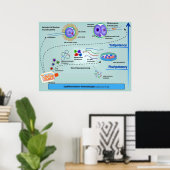
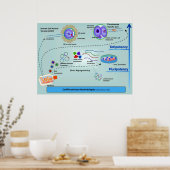
Diagram of Cellular Differentiation Methods ポスター
In developmental biology, cellular differentiation is the process by which a less specialized cell becomes a more specialized cell type. Differentiation occurs numerous times during the development of a multicellular organism as the organism changes from a simple zygote to a complex system of tissues and cell types. Differentiation is a common process in adults as well: adult stem cells divide and create fully differentiated daughter cells during tissue repair and during normal cell turnover. Differentiation dramatically changes a cell's size, shape, membrane potential, metabolic activity, and responsiveness to signals. These changes are largely due to highly controlled modifications in gene expression. With a few exceptions, cellular differentiation almost never involves a change in the DNA sequence itself. Thus, different cells can have very different physical characteristics despite having the same genome.
Dedifferentiation to totipotency or pluripotency: an overview of methods. Various methods exist to revert adult somatic cells to pluripotency or totipotency. In the case of totipotency, reprogramming is mediated through a mature metaphase II oocyte as in somatic cell nuclear transfer (Wilmut et al., 1997). Recent work has demonstrated the feasibility of enucleated zygotes or early blastomeres chemically arrested during mitosis, such that nuclear envelope break down occurs, to support reprogramming to totipotency in a process called chromosome transfer (Egli and Eggan, 2010).
Direct reprogramming methods support reversion to pluripotency; though, vehicles and biotypes vary considerably in efficiencies (Takahashi and Yamanaka, 2006). Viral-mediated transduction robustly supports dedifferentiation to pluripotency through retroviral or DNA-viral routes but carries the onus of insertional inactivation. Additionally, epigenetic reprogramming by enforced expression of OSKM through DNA routes exists such as plasmid DNA, minicircles, transposons, episomes and DNA mulicistronic construct targeting by homologous recombination has also been demonstrated; however, these methods suffer from the burden to potentially alter the recipient genome by gene insertion (Ho et al., 2010). While protein-mediated transduction supports reprogramming adult cells to pluripotency, the method is cumbersome and requires recombinant protein expression and purification expertise, and reprograms albeit at very low frequencies (Kim et al., 2009). A major obstacle of using RNA for reprogramming is its lability and that single-stranded RNA biotypes trigger innate antiviral defense pathways such as interferon and NF-kB-dependent pathways. In vitro transcribed RNA, containing stabilizing modifications such as 5-methylguanosine capping or substituted ribonucleobases, e.g. pseudouracil, is 35-fold more efficient than viral transduction and has the additional benefit of not altering the somatic genome (Warren et al., 2010).
An overarching goal of reprogramming methods is to replace genes with small molecules to assist in reprogramming. No cocktail has been identified to completely reprogram adult cells to totipotency or pluripotency, but many examples exist that improve the overall efficiency of the process and can supplant one or more genes by direct reprogramming routes (Feng et al., 2009; Zhu et al., 2010).
Image reproduction rights can be found in the link near the bottom of this description.
Sign up to Mr. Rebates for FREE and save 12% on any zazzle order in addition to a $5.00 sign up bonus
All Rights Reserved; without: prejudice, recourse or notice (U.C.C. 1-308)
Image Reproduction Rights:
http://en.wikipedia.org/w/index.php?title=File:Dedifferentiation_Methods_%282010%29_-_Bischoff,_Steven_R.tif&page=1
differentiation "Cellular differentiation" "cell biology" "cellular biology" cell biology diagram "differentiation method" totipotency pluripotency chart diagram science "science chart" "science diagram" "school chart" "school diagram" "teacher's aid"

カスタマーレビュー
5つ星評価のうち星4.6全レビュー数 42
レビュー:42
類似商品のレビュー
5つ星評価のうち星5.0
5つ星評価のうち星5kumi2024年3月11日 • 認証済みのご注文
ポスター、サイズ: 40.64cm x 30.48cm, ハードウェア: なし, フレーム: なし, メディア: 標準セミグロス, マット: なし,
とても綺麗に仕上がりました。思ったように印刷されています。 パソコンデータとほとんど変わりなくカラーも再現されて細部も綺麗に印刷されていました。
5つ星評価のうち星5.0
5つ星評価のうち星5kumi2024年3月11日 • 認証済みのご注文
ポスター、サイズ: 40.64cm x 30.48cm, ハードウェア: なし, フレーム: なし, メディア: 標準セミグロス, マット: なし,
とても綺麗に印刷されていました。用意した額に入れて飾っています。 カラーについても鮮やかに印刷されていてよかったです。ありがとうございました。
5つ星評価のうち星5.0
5つ星評価のうち星5kumi2024年3月11日 • 認証済みのご注文
ポスター、サイズ: 40.64cm x 30.48cm, ハードウェア: なし, フレーム: なし, メディア: 標準セミグロス, マット: なし,
鮮やかなカラーも再現されていてとてもよく仕上がっていました。
用意した額に飾っています。 カラーも綺麗に再現されプリントも綺麗でした。満足の仕上がりです。
タグ
その他の情報
商品 ID: 228510229265579076
出品日: 2011/7/26 13:58
レーティング: G