
カスタムカットビニールシールについて
販売:
このデザインについて
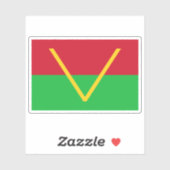
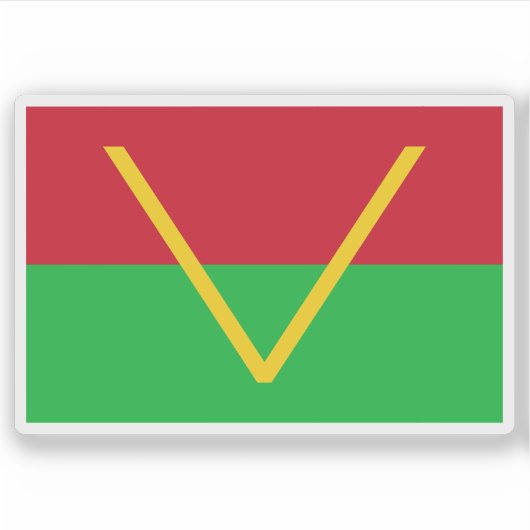
Flag of the South Kasai (1960–1962) シール
South Kasai (French: Sud-Kasaï) was an unrecognised secessionist state within the Republic of the Congo (the modern-day Democratic Republic of the Congo)[a] which was semi-independent between 1960 and 1962. Initially proposed as only a province, South Kasai sought full autonomy in similar circumstances to the much larger neighbouring state of Katanga, to its south, during the political turmoil arising from the independence of the Belgian Congo known as the Congo Crisis. Unlike Katanga, however, South Kasai did not explicitly declare full independence from the Republic of the Congo or reject Congolese sovereignty.
The South Kasaian leader and main advocate, Albert Kalonji, who had represented a faction of the nationalist movement (the Mouvement National Congolais-Kalonji or MNC-K) before decolonisation, exploited ethnic tensions between his own ethnic group, the Baluba,[b] and the Bena Lulua to create a Luba-focused state in the group's traditional heartland in the south-eastern parts of the Kasai region. As sectarian violence broke out across the country, the state declared its secession from the Congo on 9 August 1960[c] and its government and called for the Baluba living in the rest of the Congo to return to their "homeland". Kalonji was appointed president. Although the South Kasaian government claimed to form an autonomous part of a federal Congo-wide state, it exercised a degree of regional autonomy and even produced its own constitution and postage stamps. The state, supported by foreign powers, particularly Belgium, and funded by diamond exports, managed numerous crises, including those caused by the large emigration of Luba refugees, but became increasingly militarist and repressive.
Soon after its secession, South Kasaian and Congolese troops clashed after the Congolese central government ordered an offensive against it. The resulting campaign, planned to be the first act of a larger action against Katanga, was accompanied by widespread massacres of Baluba and a refugee crisis termed a genocide by some contemporaries. The state was rapidly overrun by Congolese troops. The violence in the suppression of Kasai provided much legitimacy to Joseph Kasa-Vubu's deposition of Patrice Lumumba from the office of prime minister in late 1960 and Lumumba's later arrest and assassination. As a result, South Kasai remained on relatively good terms with the new Congolese government from 1961. Its leaders, including Kalonji himself, served in both the South Kasaian government and the Congolese parliament. South Kasai continued to exercise quasi-independence while Congolese and United Nations troops were able to move through the territory without conflict with the South Kasaian gendarmerie. In April 1961, Kalonji took the royal title Mulopwe ("King of the Baluba") to tie the state more closely to the pre-colonial Luba Empire. The act divided the South Kasaian authorities and Kalonji was disavowed by the majority of South Kasai's parliamentary representatives in Léopoldville.[d] In December 1961, Kalonji was arrested on a legal pretext in Léopoldville and imprisoned, and Ferdinand Kazadi assumed power as acting head of state. UN and Congolese troops occupied South Kasai. In September 1962, shortly after his escape from prison and return to South Kasai, Kalonji was ousted by a military coup d'état which forced him into exile and brought the secession to an end.
The end of South Kasai's secession is usually held to be either December 1961, the date of Kalonji's arrest, or October 1962 with the anti-Kalonji coup d'état and final arrival of government troops.

カスタマーレビュー
5つ星評価のうち星5.0全レビュー数 1
レビュー:1
類似商品のレビュー
5つ星評価のうち星5
田原昌昭2022年3月10日 • 認証済みのご注文
エクストラスモール(特小):7.62cm x 7.62cm シート カスタムカットビニールシール, マットホワイト
Zazzleレビュープログラム
完璧です!この時代のスパイダーマンの、顔がいいですね。完璧です!つや消しのステッカーは貼りやすいから好きです
タグ
その他の情報
商品 ID: 256585147865676144
出品日: 2025/7/12 2:50
レーティング: G
最近閲覧された商品