

フリースブランケットについて
販売:
このデザインについて
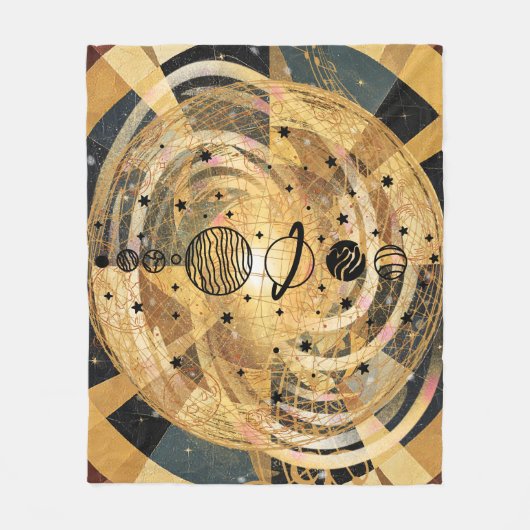
Music of the Spheres フリースブランケット
The concept of the "Music of the Spheres," or *musica universalis*, is a philosophical and cosmological idea that envisions the universe as an ordered, harmonious system governed by mathematical ratios and musical proportions. It posits that the celestial bodies—the Sun, Moon, and planets—as they move through the cosmos, produce an inaudible, cosmic symphony that reflects the deep structure of reality.
Its origins are most famously attributed to the ancient Greek philosopher Pythagoras and his followers in the 6th century BCE. They discovered that musical intervals could be expressed as simple numerical ratios, leading them to believe that the entire cosmos was constructed according to these same harmonic principles. Plato later codified this in his dialogue *Timaeus*, describing the world soul as being structured according to a musical scale, thus binding cosmology, mathematics, and music together.
During the Middle Ages, this pagan concept was absorbed and reinterpreted by Christian scholars, most notably Boethius, whose work *De Institutione Musica* became a foundational textbook for centuries. He categorized music into three types: *musica instrumentalis* (audible music made by instruments and voices), *musica humana* (the harmony between the body and soul), and *musica universalis* (the Music of the Spheres). For medieval thinkers, this celestial music was not merely a physical phenomenon but a divine and metaphysical one, the perfect harmony created by God and a testament to His order. It was considered inaudible to mortal ears, either because its perfection was beyond our comprehension or because we have been hearing it since birth and can no longer perceive it.
In the Renaissance, the idea experienced a profound revival, merging with the burgeoning fields of astronomy, natural philosophy, and esoteric traditions like alchemy and Hermeticism. Alchemists saw the Music of the Spheres as a macrocosmic reflection of their own work; the process of transmuting base metals into gold was a microcosmic attempt to create a perfect, harmonious state on Earth that mirrored the celestial harmony above. Figures like Johannes Kepler were central to this reimagining. In his groundbreaking work *Harmonices Mundi* (The Harmony of the World, 1619), Kepler attempted to find the literal music of the planets. He discovered that the orbital velocities of the planets around the Sun corresponded to musical intervals, composing a "song" for each celestial body. While he acknowledged this music was inaudible, he believed it was a real, physical expression of the divine mathematical order of the universe. Kepler's work effectively transformed the Music of the Spheres from a purely philosophical metaphor into a testable, albeit ultimately poetic, scientific hypothesis, marking its final evolution before the rise of a purely mechanistic view of the cosmos in the following centuries.
Created with Canva.com, Venice.ai & love.
カスタマーレビュー
5つ星評価のうち星4.6全レビュー数 5
レビュー:5
類似商品のレビュー
5つ星評価のうち星5
a.2018年2月2日 • 認証済みのご注文
フリースブランケット, ミディアム 127cm x 152.4cm
クリエイターレビュー
肌触りが柔らかく暖かいです。オリジナルのブランケットがこの値段で買えるのは安いと思います。ミディアムサイズも欲しくなっちゃいますね。 色合い画質共に綺麗な仕上がりで、とても満足しました。
5つ星評価のうち星5
Mayumi K.2022年2月23日 • 認証済みのご注文
フリースブランケット, スモール 76.2cm x 101.6cm
Zazzleレビュープログラム
すぐに到着したので、バレンタインに間に合い、すごく喜んでもらえたのでよかったです。お値段の割に全然よく印刷されていたと思います
5つ星評価のうち星5
J.2017年11月27日 • 認証済みのご注文
フリースブランケット, スモール 76.2cm x 101.6cm
Zazzleレビュープログラム
愛犬へのプレゼントに購入しました。
肌触りが良くて、とても柔らかいです。
プリントも綺麗なので、ギフトにすると喜ばれると思います。 とても綺麗なプリントです。
カラフルな物も綺麗にプリントされると思うので、
次回はカラフルな物を自分用に購入したいと思います。
タグ
その他の情報
商品 ID: 256843605738300622
出品日: 2025/11/22 20:29
レーティング: G
最近閲覧された商品