ポスターについて
販売:
このデザインについて
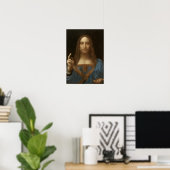
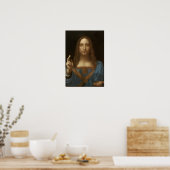
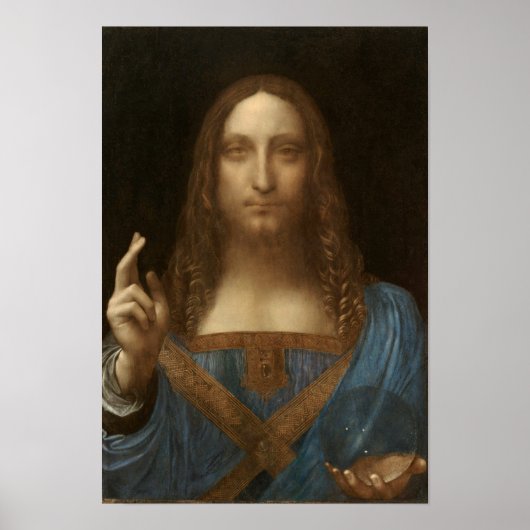
Salvator Mundi by Leonardo da Vinci ポスター
Leonardo di ser Piero da Vinci[b] (15 April 1452 – 2 May 1519) was an Italian polymath of the High Renaissance who was active as a painter, draughtsman, engineer, scientist, theorist, sculptor, and architect.[3] While his fame initially rested on his achievements as a painter, he also became known for his notebooks, in which he made drawings and notes on a variety of subjects, including anatomy, astronomy, botany, cartography, painting, and paleontology. Leonardo is widely regarded to have been a genius who epitomized the Renaissance humanist ideal,[4] and his collective works comprise a contribution to later generations of artists matched only by that of his younger contemporary, Michelangelo.[3][4]
Born out of wedlock to a successful notary and a lower-class woman in, or near, Vinci, he was educated in Florence by the Italian painter and sculptor Andrea del Verrocchio. He began his career in the city, but then spent much time in the service of Ludovico Sforza in Milan. Later, he worked in Florence and Milan again, as well as briefly in Rome, all while attracting a large following of imitators and students. Upon the invitation of Francis I, he spent his last three years in France, where he died in 1519. Since his death, there has not been a time where his achievements, diverse interests, personal life, and empirical thinking have failed to incite interest and admiration,[3][4] making him a frequent namesake and subject in culture.
Leonardo is identified as one of the greatest painters in the history of art and is often credited as the founder of the High Renaissance.[3] Despite having many lost works and less than 25 attributed major works—including numerous unfinished works—he created some of the most influential paintings in Western art.[3] His magnum opus, the Mona Lisa, is his best known work and often regarded as the world's most famous painting. The Last Supper is the most reproduced religious painting of all time and his Vitruvian Man drawing is also regarded as a cultural icon. In 2017, Salvator Mundi, attributed in whole or part to Leonardo,[5] was sold at auction for US$450.3 million, setting a new record for the most expensive painting ever sold at public auction.
Revered for his technological ingenuity, he conceptualized flying machines, a type of armored fighting vehicle, concentrated solar power, a ratio machine that could be used in an adding machine,[6][7] and the double hull. Relatively few of his designs were constructed or even feasible during his lifetime, as the modern scientific approaches to metallurgy and engineering were only in their infancy during the Renaissance. Some of his smaller inventions, however, entered the world of manufacturing unheralded, such as an automated bobbin winder and a machine for testing the tensile strength of wire. He made substantial discoveries in anatomy, civil engineering, hydrodynamics, geology, optics, and tribology, but he did not publish his findings and they had little to no direct influence on subsequent science.[8]
Despite the recent awareness and admiration of Leonardo as a scientist and inventor, for the better part of four hundred years his fame rested on his achievements as a painter. A handful of works that are either authenticated or attributed to him have been regarded as among the great masterpieces. These paintings are famous for a variety of qualities that have been much imitated by students and discussed at great length by connoisseurs and critics. By the 1490s Leonardo had already been described as a "Divine" painter.[106]
Among the qualities that make Leonardo's work unique are his innovative techniques for laying on the paint; his detailed knowledge of anatomy, light, botany and geology; his interest in physiognomy and the way humans register emotion in expression and gesture; his innovative use of the human form in figurative composition; and his use of subtle gradation of tone. All these qualities come together in his most famous painted works, the Mona Lisa, the Last Supper, and the Virgin of the Rocks.[w]
Early works
Annunciation c. 1472–1476,[d 4] Uffizi, is thought to be Leonardo's earliest extant and complete major work
Leonardo first gained attention for his work on the Baptism of Christ, painted in conjunction with Verrocchio. Two other paintings appear to date from his time at Verrocchio's workshop, both of which are Annunciations. One is small, 59 centimetres (23 in) long and 14 cm (5.5 in) high. It is a "predella" to go at the base of a larger composition, a painting by Lorenzo di Credi from which it has become separated. The other is a much larger work, 217 cm (85 in) long.[107] In both Annunciations, Leonardo used a formal arrangement, like two well-known pictures by Fra Angelico of the same subject, of the Virgin Mary sitting or kneeling to the right of the picture, approached from the left by an angel in profile, with a rich flowing garment, raised wings and bearing a lily.

カスタマーレビュー
5つ星評価のうち星4.7全レビュー数 41
レビュー:41
類似商品のレビュー
5つ星評価のうち星5.0
5つ星評価のうち星5 k.2024年3月11日 • 認証済みのご注文
ポスター、サイズ: 40.64cm x 30.48cm, ハードウェア: なし, フレーム: なし, メディア: スタンダード(セミグロス), マット: なし,
とても綺麗に仕上がりました。思ったように印刷されています。 パソコンデータとほとんど変わりなくカラーも再現されて細部も綺麗に印刷されていました。
5つ星評価のうち星5.0
5つ星評価のうち星5 k.2024年3月11日 • 認証済みのご注文
ポスター、サイズ: 40.64cm x 30.48cm, ハードウェア: なし, フレーム: なし, メディア: スタンダード(セミグロス), マット: なし,
とても綺麗に印刷されていました。用意した額に入れて飾っています。 カラーについても鮮やかに印刷されていてよかったです。ありがとうございました。
5つ星評価のうち星5.0
5つ星評価のうち星5 k.2024年3月11日 • 認証済みのご注文
ポスター、サイズ: 40.64cm x 30.48cm, ハードウェア: なし, フレーム: なし, メディア: スタンダード(セミグロス), マット: なし,
鮮やかなカラーも再現されていてとてもよく仕上がっていました。
用意した額に飾っています。 カラーも綺麗に再現されプリントも綺麗でした。満足の仕上がりです。
タグ
その他の情報
商品 ID: 228889336322718550
出品日: 2022/10/6 8:43
レーティング: G