


ポスターについて
販売:
このデザインについて
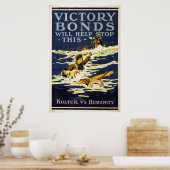
Victory Bonds will help stop this World War 1 ポスター
Kulture vs. humanity" - Poster shows a Canadian soldier holding a drowned Red Cross worker and raising his fist at the sailors on the nearby German submarine. Poster is a reference to the sinking of the Canadian Red Cross transport ship Llandovery Castle. 1918 War bonds are debt securities issued by a government for the purpose of financing military operations during times of war. War bonds generate capital for the government and make civilians feel involved in their national militaries. This system is also useful as a means of controlling inflation in such an overstimulated economy by removing money from circulation until hopefully after the war is concluded. Exhortations to buy war bonds are often accompanied with appeals to patriotism and conscience. Government-issued war bonds tend to have a yield which is below market value and are often made available in a wide range of denominations to make them affordable to all citizens. By the summer of 1940, the victories of Nazi Germany against Denmark, Norway, Belgium, the Netherlands and France brought urgency to the government discreetly preparing for possible United States involvement in World War II. Of principal concern were issues surrounding war financing. Many of President Franklin D. Roosevelt's advisers favored a system of tax increases and enforced savings program as advocated by British economist John Maynard Keynes. In theory, this would permit increased spending while decreasing the risk of inflation. Secretary of the Treasury Henry Morgenthau, Jr. however preferred a voluntary loan system and began planning a national defense bond program in the fall of 1940. The intent was to unite the attractiveness of the baby bonds that had been implemented in the interwar period with the patriotic element of the Liberty Bonds from the First World War. Morgenthau sought the aid of Peter Odegard, a political scientist specialized in propaganda, in drawing up the goals for the bond program. On the advice of Odegard the Treasury began marketing the previously successful baby bonds as "defense bonds". Three new series of bond notes, Series E, F and G, would be introduced, of which Series E would be targeted at individuals as "defense bonds". Like the baby bonds, they were sold for as little as $18.75 and matured in ten years, at which time the United States government paid the bondholder $25 Large denominations of between $50 and $1000 were also made available, all of which, unlike the Liberty Bonds of the First World War, were non-negotiable bonds. For those that found it difficult to purchase an entire bond at once, 10 cent savings stamps could be purchased and collected in Treasury approved stamp albums until the recipient had accumulated enough stamps for a bond purchase. The name of the bonds was eventually changed to War Bonds after the Japanese attack on Pearl Harbor on 7 December, 1941, which resulted in the United States entering the war. The War Finance Committee was placed in charge of supervising the sale of all bonds, and the War Advertising Council promoted voluntary compliance with bond buying. Popular contemporary art was used to help promote the bonds. More than a quarter of a billion dollars worth of advertising was donated during the first three years of the National Defense Savings Program. The government appealed to the public through popular culture. Norman Rockwell's painting series, the Four Freedoms, toured in a war bond effort that raised $132 million. Bond rallies were held throughout the country with famous celebrities, usually Hollywood film stars, to enhance the bond advertising effectiveness. The Music Publishers Protective Association encouraged its members to include patriotic messages on the front of their sheet music like "Buy U.S. Bonds and Stamps". Over the course of the war 85 million Americans purchased bonds totaling approximately $185.7 billion. National Service Board for Religious Objectors offered civilian bonds in the United States during World War II, primarily to members of the historic peace churches as an alternative for those who could not conscientiously buy something meant to support the war. These were U.S. Government Bonds not labeled as defense bonds. In all, 33,006 subscriptions were sold for a total value of $6,740,161, mostly to Mennonites, Brethren and Quakers.

カスタマーレビュー
5つ星評価のうち星4.7全レビュー数 41
レビュー:41
類似商品のレビュー
5つ星評価のうち星5
k.2024年3月11日 • 認証済みのご注文
ポスター、サイズ: 40.64cm x 30.48cm, ハードウェア: なし, フレーム: なし, メディア: バリューポスター用紙(セミグロス), マット: なし,
とても綺麗に仕上がりました。思ったように印刷されています。 パソコンデータとほとんど変わりなくカラーも再現されて細部も綺麗に印刷されていました。
5つ星評価のうち星5
k.2024年3月11日 • 認証済みのご注文
ポスター、サイズ: 40.64cm x 30.48cm, ハードウェア: なし, フレーム: なし, メディア: バリューポスター用紙(セミグロス), マット: なし,
とても綺麗に印刷されていました。用意した額に入れて飾っています。 カラーについても鮮やかに印刷されていてよかったです。ありがとうございました。
5つ星評価のうち星5
k.2024年3月11日 • 認証済みのご注文
ポスター、サイズ: 40.64cm x 30.48cm, ハードウェア: なし, フレーム: なし, メディア: バリューポスター用紙(セミグロス), マット: なし,
鮮やかなカラーも再現されていてとてもよく仕上がっていました。
用意した額に飾っています。 カラーも綺麗に再現されプリントも綺麗でした。満足の仕上がりです。
タグ
その他の情報
商品 ID: 228619836205281642
出品日: 2009/7/16 10:43
レーティング: G
最近閲覧された商品