

キャップについて
販売:
このデザインについて
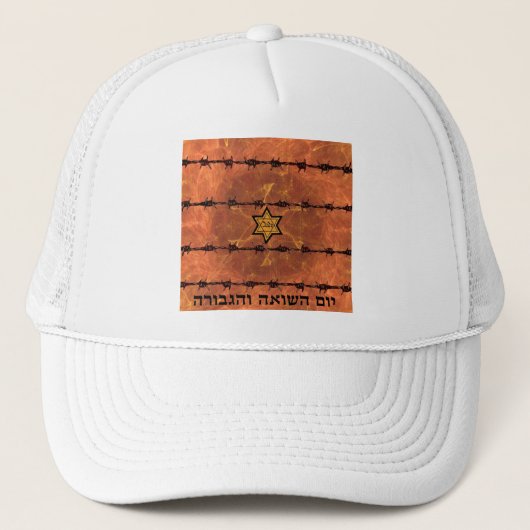
Yom HaShoah キャップ
The image consists of barbed wire, a yellow star badge the Nazis forced Jews to wear and Hebrew text which translates as Remembrance Day of the Holocaust and Heroism" superimposed on a flame-like background. Yom Hashoah Ve-Hagevurah — "Remembrance Day of the Holocaust and Heroism" is marked on the 27th day in the month of Nisan — a week after the seventh day of Passover, and a week before Yom Hazikaron (Memorial Day for Israel's fallen soldiers). It marks the anniversary of the Warsaw Ghetto uprising. The date was selected by the Knesset (Israeli Parliament) on April 12, 1951. The full name became formal in a law that was enacted by the Knesset on August 19, 1953. Although the date was established by the Israeli government, it has become a day commemorated by Jewish communities and individuals worldwide. In the early 1950s, education about the Holocaust (Shoah, meaning catastrophe, in Hebrew) emphasized the suffering inflicted on millions of European Jews by the Nazis. Surveys conducted in the late 1950s indicated that young Israelis did not sympathize with the victims of the Holocaust, since they believed that European Jews were "led like sheep for slaughter." The Israeli educational curriculum began to shift the emphasis to documenting how Jews resisted their Nazi tormentors through "passive resistance" — retaining their human dignity in the most unbearable conditions — and by "active resistance," fighting the Nazis in the ghettos and joining underground partisans who fought the Third Reich in its occupied countries. Since the early 1960s, the sound of a siren on Yom Hashoah stops traffic and pedestrians throughout the State of Israel for two minutes of silent devotion. The siren blows at sundown and once again at 11:00 A.M. on this date. All radio and television programs during this day are connected in one way or another with the Jewish destiny in World War II, including personal interviews with survivors. Even the musical programs are adapted to the atmosphere of Yom Hashoah. There is no public entertainment on Yom Hashoah, as theaters, cinemas, pubs, and other public venues are closed throughout Israel. Many Orthodox and ultra-Orthodox rabbis have never endorsed this memorial day, nor have they formally rejected it. There is no change in the daily religious services in some Orthodox synagogues on Yom Hashoah. The Orthodox Rabbinate of Israel attempted to promote the Tenth of Tevet — a traditional fast day commemorating the beginning of the siege of Jerusalem in ancient times — as the "General Kaddish Day" in which Jews should recite the memorial prayer and light candles in memory of those who perished in the Holocaust. Several ultra-Orthodox rabbis have recommended adding piyyutim (religious poems) that were written by contemporary rabbis to the liturgy of the Ninth of Av, and many communities follow this custom. Ismar Schorsch, the chancellor of the Conservative movement's Jewish Theological Seminary, has also suggested moving Holocaust commemorations to Tisha b'Av, because that is the day in which Judaism ritualizes its most horrible destructions. Jews in North America observe Yom Hashoah within the synagogue as well as in the broader Jewish community. Commemorations range from synagogue services to communal vigils and educational programs. A few congregations find it more practical to hold commemorative ceremonies on the closest Sunday to Yom Hashoah. Many Yom Hashoah programs feature a talk by a Holocaust survivor, recitation of appropriate songs and readings, or viewing of a Holocaust-themed film. Some communities choose to emphasize the depth of loss that Jews experienced in the Holocaust by reading the names of Holocaust victims one after another — dramatizing the unfathomable notion of six million deaths. Many Jewish schools also hold Holocaust-related educational programs on or near Yom Hashoah. Rituals associated with Yom Hashoah are still being created and vary widely among synagogues. Attempts have also been made to observe this memorial day at home. One suggestion is that every Jewish home should light a yahrzeit (memorial) candle on this day. There have been numerous attempts to compose special liturgy (text and music) for Yom Hashoah. In 1988 the Reform movement published Six Days of Destruction. This book, co-authored by Elie Wiesel and Rabbi Albert Friedlander, was meant to be viewed as a "sixth scroll," a modern addition to the five scrolls that are read on specific holidays. Six narratives from Holocaust survivors are juxtaposed to the six days of creation found in Genesis. In 1984, Rabbi David Golinkin of the Masorti (Conservative) movement in Israel wrote an article in which he suggested a program of observance for Yom HaShoah, which included fasting. One of the most recent achievements is Megillat Hashoah (The Holocaust Scroll) created by the Conservative movement as a joint project of rabbis and lay-leaders in Canada, the U.S., and Israel. This Holocaust scroll contains personal recollections of Holocaust survivors and is written in biblical style. It was composed under the direction of Professor Avigdor Shinan of Hebrew University and published by the International Rabbinical Assembly, the international body of Conservative rabbis, and the Masorti (Conservative) movement's Schecter Institute of Jewish Studies in Jerusalem. Rabbi Avraham (Avi) Weiss, a modern Orthodox rabbi in New York, wrote a special Haggadah for the Yom HaShoah seder, to be read in a seder (much like on Passover and Tu b'Shevat) in which the story of the Holocaust is retold. Source: My Jewish Learning, Learn@JTS, Rabbi David Golinkin "Yom Hashoah: A Program of Observance", Conservative Judaism, Vol. XXXVII, no. 4 (Summer 1984), p. 52-64

カスタマーレビュー
5つ星評価のうち星4.6全レビュー数 10
レビュー:10
類似商品のレビュー
5つ星評価のうち星4.0
5つ星評価のうち星4Kyle H.2019年12月24日 • 認証済みのご注文
トラッカーハット, ホワイトとホワイト
クリエイターレビュー
The Trucker cap is very lite weight, feels like you're not even wearing a hat. Breathable mesh is great, the brim is easy to mold. Pretty happy. The print turned out pretty good, could be a bit bolder and brighter but other then that, pretty happy.
5つ星評価のうち星5.0
5つ星評価のうち星5Michiro S.2021年8月21日 • 認証済みのご注文
トラッカーハット, ホワイトとホワイト
クリエイターレビュー
商品品質は、コストパフォーマンス的には良い方と考えます。
耐久性は、通常だと思います。仕上がりという意味では、期待より上でした。
白いトラッカーハットでしたが、色味は清潔な真っ白で、帽子のツバが思った以上に長く被ると想像より格好良いです! とりわけサマーシーズンには、映えると思います。 印刷品質は、満足できる仕上がりでした。画質的には、正直細い線は期待できないと思っていましたが、中々に表現できていたのは驚きでした。
色合いは、むずかしい下地の影響があり無理らしからぬことでありますが、ややコントラストが僅かに高い感じですけれど(写真では確認がむずかしいですが)、上出来と思います。Zazzle100%本気の仕上げであれば、満足できるレベルにあると思えます。
5つ星評価のうち星5.0
5つ星評価のうち星5Hara T.2016年8月17日 • 認証済みのご注文
トラッカーハット, ホワイトとブラック
Zazzleレビュープログラム
暑い夏を乗り切るために白い帽子を探していました。
品質・耐久性ともに申し分ないです。 白い帽子とデザインとの相性がとても良く、夏の必須アイテムとなりました。
タグ
その他の情報
商品 ID: 148931356687395449
出品日: 2013/6/7 6:48
レーティング: G