ポスターについて
販売:
このデザインについて
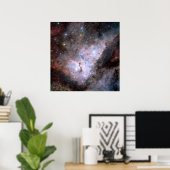
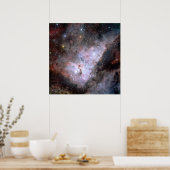
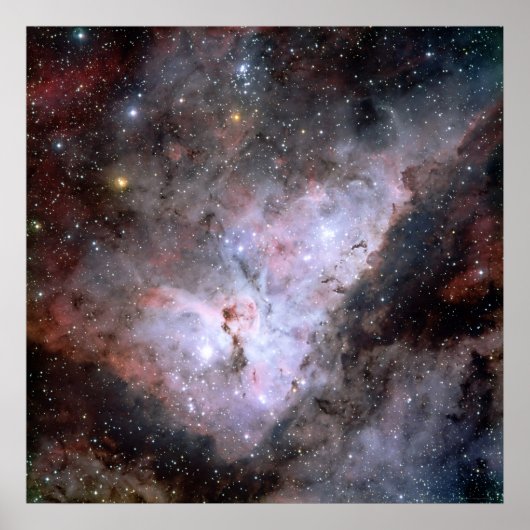
Carina Nebula Composite 40x40 (28x28) ポスター
Recommended size to fit a standard frame: 40x40 inches (original size: 28x28 inches at 300 PPI, 71 MP). Many other sizes available. Click 'Customize it!' on the right.
The large and beautiful image displays the full variety of this impressive skyscape, spattered with clusters of young stars, large nebulae of dust and gas, dust pillars, globules, and adorned by one of the Universe's most impressive binary stars. It was produced by combining exposures through six different filters from the Wide Field Imager (WFI), attached to the 2.2 m ESO/MPG telescope at ESO's (European Southern Observatory) La Silla Observatory, in Chile.
The Carina Nebula is located about 7500 light-years away in the constellation of the same name (Carina; the Keel). Spanning about 100 light-years, it is four times larger than the famous Orion Nebula and far brighter. It is an intensive star-forming region with dark lanes of cool dust splitting up the glowing nebula gas that surrounds its many clusters of stars.
The glow of the Carina Nebula comes mainly from hot hydrogen basking in the strong radiation of monster baby stars. The interaction between the hydrogen and the ultraviolet light results in its characteristic red and purple colour. The immense nebula contains over a dozen stars with at least 50 to 100 times the mass of our Sun. Such stars have a very short lifespan, a few million years at most, the blink of an eye compared with the Sun's expected lifetime of ten billion years.
One of the Universe's most impressive stars, Eta Carinae, is found in the nebula. It is one of the most massive stars in our Milky Way, over 100 times the mass of the Sun and about four million times brighter, making it the most luminous star known. Eta Carinae is highly unstable, and prone to violent outbursts, most notably the false supernova event in 1842. For just a few years, Eta Carinae became the second brightest star in the night sky and produced almost as much visible light as a supernova explosion (the usual death throes of a massive star), but it survived. Eta Carinae is also thought to have a hot companion that orbits around it in 5.54 years, in an elliptical orbit. Both stars have strong winds, which collide, leading to interesting phenomena. In mid-January 2009, the companion was at its closest distance to Eta Carinae. This event, which may provide a unique insight into the wind structure of the massive stars, has been followed by a flotilla of instruments on several of ESO's telescopes.
ESO (European Southern Observatory)

カスタマーレビュー
5つ星評価のうち星4.7全レビュー数 41
レビュー:41
類似商品のレビュー
5つ星評価のうち星5.0
5つ星評価のうち星5 k.2024年3月11日 • 認証済みのご注文
ポスター、サイズ: 40.64cm x 30.48cm, ハードウェア: なし, フレーム: なし, メディア: 標準セミグロス, マット: なし,
とても綺麗に仕上がりました。思ったように印刷されています。 パソコンデータとほとんど変わりなくカラーも再現されて細部も綺麗に印刷されていました。
5つ星評価のうち星5.0
5つ星評価のうち星5 k.2024年3月11日 • 認証済みのご注文
ポスター、サイズ: 40.64cm x 30.48cm, ハードウェア: なし, フレーム: なし, メディア: 標準セミグロス, マット: なし,
とても綺麗に印刷されていました。用意した額に入れて飾っています。 カラーについても鮮やかに印刷されていてよかったです。ありがとうございました。
5つ星評価のうち星5.0
5つ星評価のうち星5 k.2024年3月11日 • 認証済みのご注文
ポスター、サイズ: 40.64cm x 30.48cm, ハードウェア: なし, フレーム: なし, メディア: 標準セミグロス, マット: なし,
鮮やかなカラーも再現されていてとてもよく仕上がっていました。
用意した額に飾っています。 カラーも綺麗に再現されプリントも綺麗でした。満足の仕上がりです。
タグ
その他の情報
商品 ID: 228234182215159443
出品日: 2009/11/30 11:11
レーティング: G